
If you’ve ever sat through an IEP meeting where the student stared blankly at the floor while adults tossed around acronyms and legal language… welcome to the club. The truth is, we talk a lot about students in these meetings, but the real magic happens when we start teaching them to talk about themselves — with confidence.
That’s where self-advocacy skills come in. And teaching them doesn’t have to be overwhelming. In fact, with a little structure, humor, and the right lesson plans, you can help students go from passive participants to empowered leaders.

Most teenagers could use some coaching in how to advocate appropriately (let’s be honest). But for our students on IEPs, strong self-advocacy IEP goals can play a crucial role in shaping their transition plans and post-secondary future. It’s not just another box to check — it’s a real-life skill with lifelong value.
Why Teaching Self-Advocacy Important
Self-advocacy is an important skill — not just for school, but for life. Teaching self-advocacy goals means helping students:
- Understand that they have a voice — and it’s okay to use it
- Identify and express their personal strengths and personal needs
- Take an active role in their education and goal setting
- Speak up appropriately in different situations and settings
- Participate meaningfully in transition plans for life after high school
- Build self-determination skills, confidence, and independence (if you’re wondering how self-determination differs from self-advocacy, add in decision making, problem solving, and planning).
And for students with special needs, self-advocacy is a crucial skill that supports short-term success in the learning environment and long-term independence. It helps them communicate with teachers, support staff, and peers — and eventually, with professors, bosses, doctors, landlords, friends, and partners.
It’s the kind of skill that goes beyond academics. Teaching self-advocacy helps students speak up about their specific accommodations, say no to peer pressure, hold boundaries in relationships, or ask questions at an appointment. Using effective communication is a skill that needs to be taught. We can give this to our students in a way that makes them feel empowered instead of embarrassed (as most teens are).

How to Actually Teach Self-Advocacy (Without Making Students Feels Weird)
Let’s break this down into practical, low-pressure steps you can use in a middle school or high school learning environment. Whether you’re a special education teacher, a speech therapist, or a general ed teacher supporting inclusion, these ideas work.
1. Start with Engaging Discussions
You don’t have to start with heavy legal jargon. In fact, there’s no faster way to bore students. Begin with open classroom discussions about what self-advocacy means and why it matters.
Use examples tied to real student experiences — like requesting to use a calculator, not knowing how to talk to a friend when you’re upset, or navigating a group project disaster. Steer away from broad, abstract questions. Ask specific questions that really get them thinking, like-
- Have you ever been in a situation where you wished you’d spoken up for yourself? What happened when you didn’t?
- Why do you think people sometimes feel nervous or afraid to ask for what they need?
- How do you think speaking up for yourself at school or work might differ from when you’re at home or with friends?
These conversations, whether held as a class, small group, or 1:1, build awareness and normalize the idea that advocating for one’s own needs is not just okay—it’s empowering.
👉 Pro Tip: Tie these talks back to transition plans and future goals. Frame self-advocacy as a real-world skill, not just a school skill.
2. Teach Them Their Rights (Without Putting Everyone to Sleep)
In order to know when, where, and why to speak up, students need to understand their rights. This includes rights laid out in their individualized education program (IEP) and rights in other vital areas of life, such as school, work, medical settings, and even public spaces.
Let’s be honest: this part can go off the rails fast. Start reading from a procedural safeguards document, and your students will zone out quicker than you can say “due process.” But here’s the thing — if students don’t know their rights, how can they advocate for themselves?
So yes, teach the rights — but ditch the legal jargon and make it relatable. You’re not training lawyers; you’re helping students understand what they’re entitled to, what they can ask for, and how to recognize when something isn’t right.
✅ Start with their IEP: Do they know what their IEP accommodations are? Can they explain them in their own words? Have they ever actually seen their IEP (shocking, but true — many haven’t!)?
✅ Go beyond school: Do they know their rights at work? (Spoiler: Yes, they can ask for reasonable accommodations!) What about doctor’s offices, counseling sessions, or when they’re applying for college or trade programs?
✅ Use simple language and real-life scenarios: Instead of saying “Section 504 of the Rehabilitation Act of 1973,” say, “You have the right to ask for help, and adults are legally supposed to listen.” Boom — instant clarity.
👉 Pro Tip: Use short readings, matching games, or real-world examples to teach this. For example: “You have a hard time focusing and need breaks — which accommodation could help you at your part-time job?” Pair it with a class discussion to keep it engaging.
3. Build Effective Communication Skills
This is really where the rubber hits the road. Students can’t advocate if they don’t know how to speak up respectfully and clearly. First, they need instruction. Then they need practice, practice, and more practice. Instruction should focus on:
- How to ask for help using an “I” statement
- Describing a problem without blaming
- Understanding and explaining their specific accommodations
- Choosing the right moment (timing really is everything)
👉 Pro Tip: Try a “rude to respectful” activity where students reword blunt phrases into confident, polite self-advocacy. For example:
“This is dumb!” should switch to “I don’t understand. Can you explain it another way?”
This kind of self-advocacy strategy improves behavior, relationships, and social-emotional skills — all while reinforcing effective communication.

4. Help Students Set Self-Advocacy Goals
Let students take ownership. Writing self-advocacy IEP goals shouldn’t just be something the adults do and read aloud in a meeting. Bring students into the process. Ask them:
- What are your strengths? What are your needs?
- What support do you need in the classroom? At work? In the community?
- What’s one thing you’d like to be able to say or ask for on your own?
Collaboratively write effective IEP goals that reflect student voice, are specific and measurable, and grow with them.
👉 Pro Tip: Even simple goals like “I will ask for a break using my script in 3 out of 5 classes per week” can make a big impact.
5. Use Real-World Scenarios in Different Settings
Practice makes progress. Students need to see self-advocacy in practice and then rehearse it in low-stakes situations to prepare them for high-stakes ones.
- Start with some simple multiple-choice scenarios- this shows them what different responses could look like.
- Matching activities- have students match a scenario with the correct response.
- Role-playing is fantastic. For students who hate role-playing, give them a scenario and have them write what they’d say instead.
- Students should start practicing advocacy and recognizing it. Reflection journals to track responses and emotions when those real-world self-advocacy scenarios pop up is key.
Help them apply skills across different settings — the classroom, cafeteria, job sites, doctor’s office, even at home.
Get started with the FREE worksheets of School Scenarios!
👉 Pro Tip: Teacher observation is essential- students don’t always know when to speak up. Until they do, you might need to encourage them when those opportunities pop up, and when they do, remind them to use that journal. Over time, you’ll see real growth in how students approach specific needs and solve problems independently.
6. Reinforce Progress in a Supportive Environment
Self-advocacy doesn’t stick if the environment feels unsafe. Foster a supportive classroom environment with:
- Clear rules and predictable routines
- Feedback that highlights effort, not just correctness
- Celebrations of student voice and participation
- Support from all IEP team members
👉 Pro Tip: Students need regular check-ins. Make time to revisit self-advocacy goals, adjust strategies, and celebrate growth.
Want to Make It Easier?
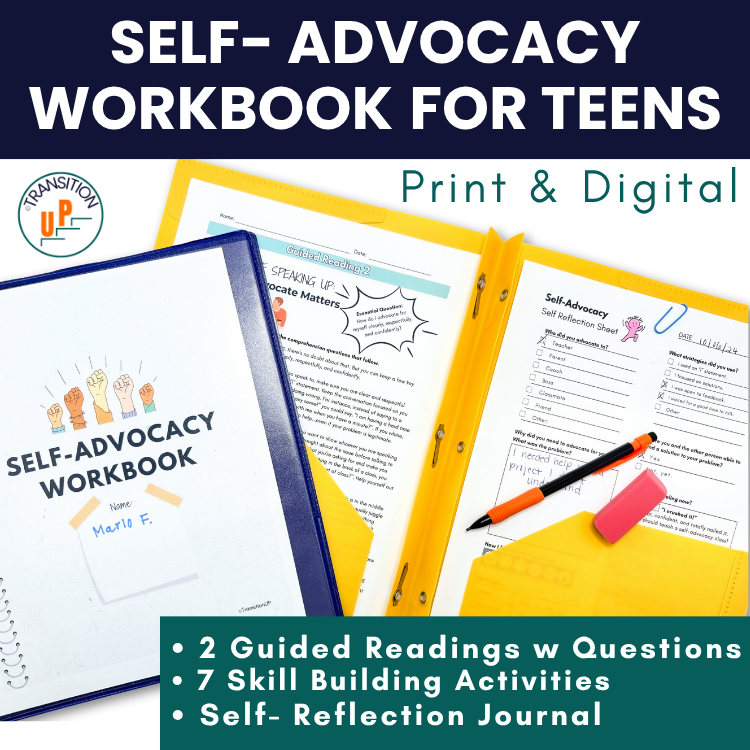
If you’re thinking, “This sounds great, but I don’t have time to create all this,” I’ve got your back. I created a ready-to-use Self-Advocacy Workbook for Teens that removes the guesswork. It includes:
- 2 Guided Readings and comprehension questions
- 15 Discussion Questions
- An overview of legal rights in different settings
- Understanding personal strengths and needs at school
- Helps students get to know their accommodations
- Multiple choice scenarios for school, work, and social environments
- A “rude to respectful” communication skills activity
- A reusable self-advocacy journal to track growth
- Matching activities (two levels!) for legal rights in various contexts
- Full answer keys for easy feedback or sub plans
- PDF & Digital options
This resource is perfect for special education teachers, speech therapy sessions, push-in support, or any setting where you’re building self-determination skills and tracking student progress through effective IEP goals.
Check out the Self-Advocacy Workbook here!
Final Thoughts
When students take an active role in their education, everything changes. They grow from “I don’t know” to “Here’s what I need.” They step into meetings with questions. They solve problems before they explode. And most importantly, they start to believe in themselves. Teaching self-advocacy isn’t about prepping them for one meeting. It’s about giving them the tools to handle life’s many meetings — in classrooms, doctor’s offices, jobs, and relationships. And hey, if you can guide them through that and survive IEP season with your sanity intact? You’re already a legend. Or at least, you’ve earned a coffee and a quiet corner to sip it in.
