Let’s be real for a minute — writing transition IEP goals can be daunting. Actually, the whole transition planning process can be daunting. You’re trying to make everything perfect, meet all the requirements, and keep the entire Team (including the student, their family members, and possibly even a transition specialist) on the same page.
But fear not! I was a teacher and transition specialist, and writing effective IEP goals doesn’t have to be overwhelming. You can nail transition services with a bit of preparation, the right tools, and maybe a cup of coffee (or three).
Helping students move from school to postsecondary life takes collaboration, clarity, and strong IEP transition goals. Whether you’re working with middle school or high school students, writing clear, specific goals tailored to a student’s unique needs can be the key to a successful transition. The best part of transition planning is that you truly get to know your students; their hopes, dreams, and future visions.
Effective transition IEP goals should reflect a student’s strengths, preferences, and vision for the future. Sometimes, these goals are spot-on and practical for their current skill level. Other times, we work with students whose goals are more… ambitious (I’ve heard dreams of becoming an NFL superstar, the next president, or even the next Brad Pitt).
As teachers, it’s our job to listen to and honor these big dreams while creating a realistic and meaningful roadmap to help them reach their goals. And hey, some kids might be able to reach these lofty goals! Let’s break down the transition process.
What Are Transition Goals? And Why Do They Matter?
Transition goals should act as a map that guides students toward their vision of an adult life. These goals are meant to help students move from school life to the real world, and they cover three main areas:
- Post-secondary education or vocational training
- Employment
- Independent living (because, let’s be honest, at some point they have to figure out how to fold laundry… or at least how to microwave pizza without setting off the smoke alarm).
These three areas can include a vast (and sometimes overwhelming) range of skills. For instance, independent living can consist of skills such as cooking, renting an apartment, managing finances, or a million other things we do to function as independent adults. It’s up to you and the IEP team to determine which areas are top priority regarding student instruction.
Post-secondary goals aren’t just something you toss into the IEP and forget about. They’re part of IEP transition planning and need to be specific, measurable, and aligned with the student’s unique needs and dreams for the future. And while you may be working with middle school or high school students, the process is essentially the same: preparing them for what comes next!
The Basic Ingredients of a Good Transition Goal
You wouldn’t bake a cake without flour (well, you can, but the results might be questionable), and you shouldn’t write transition IEP goals without these key ingredients.
1. The Transition Assessment
So, how do we begin the transition planning process? This is the fun part (to me, at least)!
Start with age-appropriate transition assessments. These assessments don’t have to be scary. They involve asking the student questions like, “Hey, what do you think you might want to be when you grow up?” or “What do you enjoy doing?” and “What’s something you can do without needing someone to remind you (because let’s face it, we all need reminders sometimes)?” You’ll want to dig into their strengths, challenges, hopes, and dreams.
Their areas of interest will guide you. Whether it’s a vocational program in auto repair, an internship in graphic design, or a summer job at the local coffee shop, knowing what lights up the student’s world is crucial. Tip: Make sure the student’s voice is heard! If they want to be movie stars, don’t squash that dream. Set a realistic path to get there (or something in the ballpark)—think local theatre program for those A-List movie star dreamers.
Transition assessments can vary in complexity and formality. I often wrote formal Transition Assessments as part of a comprehensive 3-year reevaluation. These are usually more in-depth, involve formal evaluations, and are typically for students who require more substantial support as they move toward greater independence.
On the flip side, transition planning and assessments are also an informal part of the annual IEP planning process. Which route you go depends on the student’s needs, but transition planning is necessary for the IEP process. The timing of when this process begins depends on your state. Federal law mandates transition must be discussed by 16 years of age, but some states require it to begin earlier. Make sure you know the deal in your area.
There are quick and easy ways to get started on less formal evaluations, like using my IEP & Transition Planning Toolkit, which helps streamline the process and gives you a clearer picture of your student’s needs and goals.
2. The Big Picture Vision
The point of a Transition Assessment is to create a vision of a student’s adult life. Now, visions change, and that’s okay. No one’s future is set in stone, but it gives the team a good place to start, and if things change over the years, that’s not a bad thing- it might mean the student is getting to know themselves more! Once you have that vision, you’ll determine which skills and what type of instruction the student still needs to reach it.
Annual goals are like the stepping stones on the path to the Team’s vision of a student’s adult life. Depending on when you start this process, you may have a few years to focus on different areas of instruction. Don’t overdo it if you can spread it out over time.
If you’re short on time, work with the team to determine which areas require real support and focused instruction outside of what the parents can provide (for example, parents might be able to help a student get their license). Focus on smaller benchmarks to help students build skills to achieve their postsecondary dreams. Maybe they need to work on functional skills like budgeting or practicing interviews. Whatever it is, the annual goals should help them get closer to that successful transition.
3. Gooooooals!!
You probably already write specific and measurable annual IEP Goals for academic skills. Transition goals are no different! Let’s say John loves fashion and wants to get into retail. Don’t write a goal like: “John will work toward becoming a better retail employee.” That’s vague, and even John might be like, “Uh… what does that even mean?”
Instead, aim for something clear and measurable. You’ve probably already heard of SMART Goals (specific, measurable, achievable, realistic, time-bound), that’s what we’re aiming for. Let’s look at an example:
Goal Statement: By the end of the school year, John will secure a part-time job at a local retail store and complete all required workplace training, with 80% independence as documented by teacher or job coach observation.
The key here is specificity. A solid transition IEP goal should include what the student will do, how they’ll do it, and when they’ll do it. That way, you’re not chasing an abstract idea that’s as hard to pin down as a cloud in a windstorm. And don’t forget — goals should be broken down into benchmarks or short-term objectives that help track a student’s progress and make the larger goal manageable. For John’s goal, benchmarks might look like this:
- Benchmark 1: With teacher support, John will research at least five local retail stores with current job openings and identify three positions of interest, demonstrating 80% accuracy and 80% independence as measured by a teacher-created checklist.
- Benchmark 2: Given previous instruction and practice, John will independently complete and submit at least one job application per session with no more than two teacher prompts, in 4 out of 5 sessions, as measured by teacher observation and application submission.
- Benchmark 3: John will participate in two mock interviews per week for four consecutive weeks, responding to interview questions with at least 80% accuracy and demonstrating appropriate interview etiquette (e.g., eye contact, greeting, posture) in at least 3 out of 4 sessions, as measured by a teacher or job coach rubric.
- Benchmark 4: John will complete all required workplace training modules or onboarding tasks with at least 90% accuracy and no more than one prompt per task, as verified through employer or job coach documentation.
These benchmarks help ensure the IEP team can monitor John’s progress, provide the necessary support, and help him stay on track toward a successful transition into the real world. If you love a good example like me, I put some more at the bottom for you.
4. The Crew
It’s not just you doing the heavy lifting here — the IEP team needs to be involved, too. You’ll want input from:
- The student (trust me, they’ve got opinions)
- Parents (they know the real dirt on their kids)
- Teachers and paras (teachers and paras are gold mines for info- don’t forget to utilize them!)
- And maybe even a transition specialist or job coach if you’re lucky enough to have one.
The more input you get, the more appropriate support the student will have for a smooth transition to life after high school.
Examples of Transition IEP Goals That Actually Make Sense
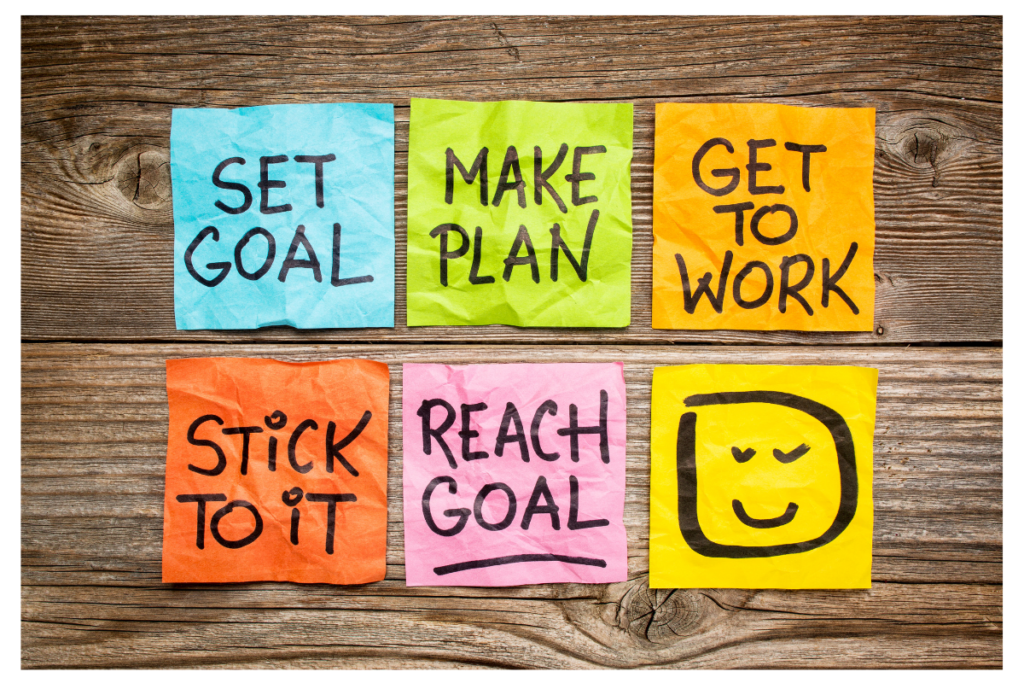
Let’s look at some examples that will make you say, “Wow, I can totally do this!”
Postsecondary Vision: Financial Independence
- Post Secondary Vision: Madison eventually wants to be financially independent.
- Financial Literacy Goal Statement: By the end of the school year, given mock budget scenarios, Madison will manage a monthly budget by tracking income and expenses and making purchases within that budget, demonstrating 85% accuracy and 75% independence, as measured by weekly teacher check-ins and submitted budget logs.
- Benchmarks/Objectives:
- Benchmark 1: By the end of Quarter 1, Madison will identify at least five common monthly expenses (e.g., rent, groceries, phone bill, transportation), with 90% accuracy in 3 out of 4 trials, as measured by teacher-created assessments.
- Benchmark 2: By the end of Quarter 2, Madison will create a mock monthly budget using a given income and a list of expenses, completing the task with 80% accuracy and no more than two prompts per session, as measured by teacher review of budget worksheets.
- Benchmark 3: By the end of the IEP period, Madison will participate in at least five real or simulated purchasing activities, demonstrating appropriate decision-making skills (e.g., distinguishing needs vs. wants) and remaining within a set budget in 3 out of 3 sessions, as measured by observation and a decision-making rubric.
- Benchmarks/Objectives:
- Financial Literacy Goal Statement: By the end of the school year, given mock budget scenarios, Madison will manage a monthly budget by tracking income and expenses and making purchases within that budget, demonstrating 85% accuracy and 75% independence, as measured by weekly teacher check-ins and submitted budget logs.
Postsecondary Vision: Community College
- Postsecondary Vision: Sarah wants to go to community college
- Post Secondary Education Goal Statement: By the end of the school year, Sarah will apply to at least three colleges by completing all necessary application components with 90% independence and no more than two prompts per task, as measured by teacher or counselor documentation.
- Benchmarks/Objectives:
- Benchmark 1: Sarah will identify and research at least five potential community colleges, documenting key findings (e.g., admission requirements, programs of interest, costs) with 90% accuracy and no more than one prompt per task, as measured by a completed college comparison chart.
- Benchmark 2: With prior self-advocacy instruction, Sarah will request and obtain three letters of recommendation, using appropriate communication skills (e.g., email, in-person request) in at least 2 out of 3 opportunities, as measured by teacher observation and request documentation.
- Benchmark 3: Sarah will complete and submit at least three college applications with 85% accuracy and no more than two prompts per application, as verified by submission records and teacher review.
- Benchmark 4: Sarah will write and revise a personal statement for college applications, achieving 90% accuracy in grammar and content, using structured feedback from a teacher or counselor, as measured by a final draft and writing rubric.
- Benchmarks/Objectives:
- Post Secondary Education Goal Statement: By the end of the school year, Sarah will apply to at least three colleges by completing all necessary application components with 90% independence and no more than two prompts per task, as measured by teacher or counselor documentation.
Postsecondary Vision: Cooking
- Postsecondary Vision: Mark wants to learn to cook so he can live independently someday.
- Cooking Goal Statement: By graduation, Mark will independently prepare at least five simple meals using microwave or cold preparation methods, demonstrating 90% accuracy and 80% independence, as measured by teacher observation and meal preparation checklists.
- Benchmarks/Objectives:
- Benchmark 1: Given a list of preferred microwave or cold prep meals, Mark will identify and list the necessary ingredients for each meal with 90% accuracy and 75% independence, as measured by completed grocery lists and teacher check-ins.
- Benchmark 2: Mark will follow written or visual step-by-step directions to prepare five simple meals (e.g., sandwich, microwave pasta, salad) with at least 85% accuracy, as observed and recorded by the teacher using a task analysis checklist.
- Benchmark 3: Mark will safely operate a microwave and demonstrate basic food safety practices (e.g., hand washing, proper food storage) in 4 out of 5 observed sessions, as measured by a safety checklist.
- Benchmark 4: After meal preparation, Mark will independently clean his workspace (e.g., wipe counters, put away ingredients, dispose of trash) with no more than one prompt in 3 out of 4 trials, as measured by teacher observation.
- Benchmarks/Objectives:
- Cooking Goal Statement: By graduation, Mark will independently prepare at least five simple meals using microwave or cold preparation methods, demonstrating 90% accuracy and 80% independence, as measured by teacher observation and meal preparation checklists.
Postsecondary Vision: Independent Self-Advocacy
- Postsecondary Vision: Emma will be able to independently advocate for her needs.
- Self-Advocacy Goal Statement: By the end of the IEP period, Emma will independently advocate for her needs with teachers, employers, and peers in academic, workplace, and social settings, demonstrating appropriate communication strategies with at least 80% accuracy, as measured by teacher observation and student reflection tools.
- Benchmarks/Objectives:
- Benchmark 1: Given guiding questions about strengths and challenges (e.g., “Do you focus best in the morning or afternoon?”), Emma will independently identify at least three personal strengths and three areas of need related to school, work, or social situations, as documented through written reflections or checklists.
- Benchmark 2: Given examples of negative or passive communication, Emma will reword the examples into respectful, assertive self-advocacy statements in 4 out of 5 opportunities with no more than one teacher prompt, as measured by teacher review and discussion.
- Benchmark 3: Given multiple-choice self-advocacy scenarios related to school, work, and social situations, Emma will choose appropriate solutions demonstrating 80% independence and accuracy, as measured by scenario assessments.
- Benchmark 4: By the end of the IEP period, Emma will independently request accommodations or help in a real-life setting (school, work, or community) with no more than one prompt in 2 out of 3 opportunities, as verified by teacher or job coach documentation.
- Benchmarks/Objectives:
- Self-Advocacy Goal Statement: By the end of the IEP period, Emma will independently advocate for her needs with teachers, employers, and peers in academic, workplace, and social settings, demonstrating appropriate communication strategies with at least 80% accuracy, as measured by teacher observation and student reflection tools.
Ready to Rock That Transition Meeting? Download My Free Checklist!
Now that you’re all set with your transition IEP goals, it’s time to get organized and crush those meetings. Download my free printable checklist to help you plan transition meetings like a pro (yes, you totally can!).
If you need more, check out the IEP & Transition Planning Toolkit. An easy, comprehensive Transition Assessment to use with students and parents. Make transition planning a breeze!
Final Thoughts (Yes, You Made It!)
You’ve got this! Writing transition IEP goals doesn’t have to be stressful. When you take into account the student’s unique needs, use clear and specific goals, and involve the right people, the process becomes a lot more manageable. And hey, you’re creating a roadmap for a successful transition to the real world — that’s something to feel good about! So, take a deep breath, grab a snack, and get those goals written. Your future rockstars will thank you for it!
